Why couples who believe in equality still end up unequal
Updated: Aug 16
Why women still do more housework, even when both partners work full time

If you've read my previous articles in this series, you might have noticed that I've been careful to frame the ‘invisible load’ as something that can fall on either partner, regardless of gender.
And that remains true; in any relationship, one person can end up as the default household manager while the other functions more as a helper. This leads to a corrosive dynamic, regardless of who's in which role.
But I also think there's value in being honest about what the research actually says. Because the research is fairly unambiguous, and pretending otherwise doesn't serve anyone, least of all the couples trying to understand why their household ended up the way it did.
What the research says
According to the United Nations, women globally still do nearly three times as much unpaid domestic work as men. This holds across countries, cultures, and income levels. It holds in households where both partners work full time. It even holds among men who (before having children) described themselves as committed to an equal division of domestic labour.
In the UK, Shared Parental Leave was introduced in 2015 to encourage parents to share childcare more equally. Yet a government evaluation found that only around 5% of eligible fathers took it up.
These aren't figures about bad men or constantly suffering women. They're figures about a structural pattern that is so deeply embedded in how we organise family life, that it persists even when individuals actively try to resist it.
Where it comes from
The pattern doesn't begin in adulthood. Research shows that teenage girls take on around 50% more household tasks than boys (i.e. doing more cleaning, more tidying, more caring) while boys are more likely to have unstructured time. The messages absorbed in those years are powerful and largely unconscious, such as what home life looks like, whose job it is, what a good mother does vs what a good father does.
Those messages then collide with a set of structural realities that reinforce them. Paternal involvement is treated as optional or exceptional (the father who does the school run is praised; the mother who doesn't is quietly judged). Workplaces are still largely organised around the assumption of an unencumbered worker with someone managing their domestic life at home. And the career cost of becoming a parent falls overwhelmingly on mothers: research consistently finds that motherhood has a substantial and lasting impact on women’s earnings, through reduced employment, part-time work and slower career progression (while a man's earnings, on average, increase).
The result is a set of forces that push in the same direction: towards one partner absorbing more of the domestic load, stepping back more from professional life, and gradually becoming the default parent.
Why good intentions aren't enough
Here's the part that matters most for couples (and generate the most resistance in the therapy room).
Most of the men I work with are not indifferent to their partner's load. They don't want their partner to be exhausted, and they genuinely believe in fairness. And yet the imbalance persists; not because of bad faith, but because good intentions, without structural change, tend to run up against something much stronger: ingrained habit, cultural default, and the path of least resistance.
If one partner has always been the one to notice when the loo roll is running low, the other partner doesn't develop the habit of noticing. If one partner always manages the school admin, the other never learns the rhythms of the school year. Capability and awareness are not fixed traits: they're products of practice. And in most households, only one partner has been practicing.
This is why "trying harder" rarely works on its own. It's also why conversations about the invisible load can feel so frustrating: the partner carrying the load can see something the other partner genuinely cannot yet see, because they've never had to.
A note on what this isn't
I'm not saying that men are lazy, or that women are victims, or that traditional arrangements are inherently wrong. Some couples make a considered choice to divide their lives in a more traditional way (e.g.: one partner focused primarily on career, the other on home and family) and find genuine satisfaction in it. That's a valid choice, provided it's actually a choice: consciously made, regularly revisited, and fair to both people.
What I am saying is that the arrangements most couples end up with are rarely the result of a genuine, fully-informed negotiation. They tend to be the result of drift: of defaults kicking in, of the path of least resistance being taken, of neither person quite deciding but both people gradually adjusting. And drift, by definition, doesn't tend to produce what either person would have chosen if they'd sat down and thought about it carefully.
The question worth asking (as a couple) is not “Whose fault is this?” but “Is this actually what we would have chosen? And if not, what would we choose instead?”
What this means in practice
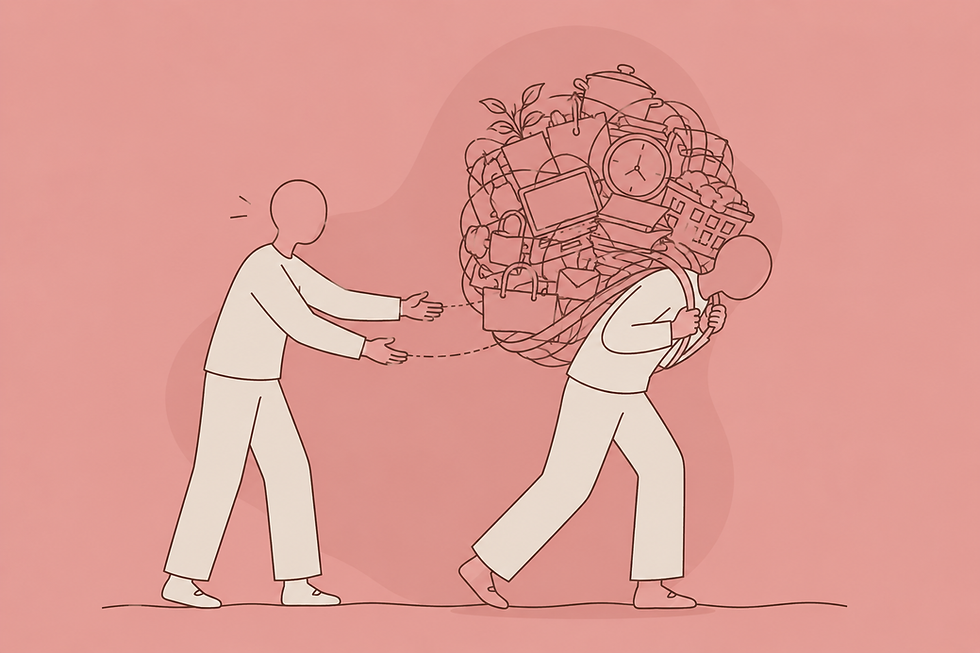
When the domestic imbalance is understood as a structural pattern rather than a personal failing (something that happened to your relationship, rather than something either of you deliberately created) the conversation shifts. It becomes less about blame and more about choice. Less about who has been ‘getting away with something’, and more about what kind of partnership you actually want to build.
That shift (from accusation to curiosity, and from grievances to design) is where most things begin to move. The invisible load becomes easier to address when both partners understand why it formed in the first place. The system becomes easier to implement when neither person feels attacked by the conversation that precedes it.
One more thing
If you're the partner who has been carrying the load, I want to name something directly: the fact that this is a structural pattern does not mean your experience is any less real, or any less worth addressing. Structural explanations are not excuses; they're context. The exhaustion is still exhaustion. The resentment is still resentment. And you are still entitled to a fairer deal - not as a favour, but as a given.
And if you're the partner who is reading this and recognising, perhaps for the first time, the full extent of what your partner has been carrying: that recognition matters. Not as a reason to just feel guilty, but as a reason to act. To bring the same energy to this problem that you'd bring to any other problem worth solving.
Because it is worth solving. Not just for the sake of fairness (though that would be reason enough) but for the sake of your relationship, your partner's wellbeing, and the model of partnership you're building together.
The next post in this series is about what happens to your sense of self when the invisible load takes over, and why reclaiming your Something™ matters as much for your relationship as it does for you.
P.S.: If the conversations in this series are ones you'd like support having, I work with couples online and in-person in London. Feel free to get in touch or book a free 45-minute initial consultation through my calendar.


Comments