Have You Lost Yourself in Your Relationship?
Why having your own interests and ambitions matters more than you think

Somewhere between the school runs and the meal planning, the work deadlines and the endless domestic admin, a lot of people lose something.
What gets lost is the part of you that existed before all of this. The person you were before you became somebody's partner, somebody's parent, the family’s household manager. The interests you had, the things you made, the version of yourself that felt most fully alive.
What happens to you when the load takes over
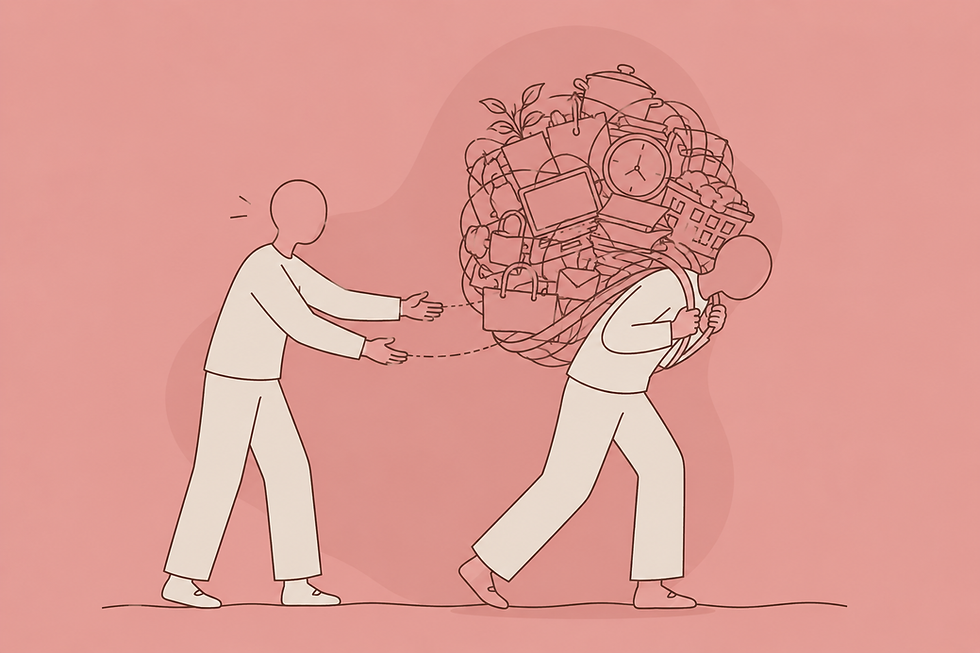
When one partner absorbs a disproportionate share of the domestic load (the invisible work, the mental labour, the constant low-level management of other people's lives) something tends to happen to them gradually, and often without either partner noticing.
The hours available for anything outside the immediate demands of home and family quietly shrink. The things that used to matter (the hobby, the creative project, the friendship group, the thing you were always going to get back to) get deferred. First for a week or two, then indefinitely. There's always something more pressing. There's always someone who needs something.
And then one day, you realise you can't quite remember what you'd do with a free afternoon. The question of what you enjoy, separate from your roles, has become genuinely hard to answer.
This is not a small thing. It tends to announce itself eventually as a low-grade restlessness, a feeling of having faded, a sense that somewhere along the way you stopped being interesting, even to yourself. Some of my clients describe it as a grief; others as a kind of disappearing.
Why this matters for your relationship
Here is the part that surprises people: losing your Something™ (more about the definition later) doesn't just affect you. It affects your relationship, often in ways that are hard to trace back to their source.
Here is a dynamic I see often in the therapy room: one partner has shrunk their world to fit the demands of domestic life, and the other has continued to have a career, friendships, interests, and a sense of individual identity outside the relationship. This causes a gap to open up. Not necessarily a dramatic one, but a quiet, growing asymmetry in how each person moves through the world. One person comes through the door with stories, whilst the other has managed the household while they were gone.
Resentment tends to follow. Sometimes it looks like a flatness, a distance, a sense of two people coexisting rather than truly meeting. The person who has lost themselves begins to hold the other responsible for it (at least in part). The other person may not understand why, or may feel unfairly blamed for a dynamic neither of them consciously created.
There is also something worth saying about desire: about what keeps two people genuinely interested in each other over time. The partner you fell in love with had a life of their own. Opinions shaped by things they'd thought about and pursued and cared about. A spark that had nothing to do with you, and everything to do with who they were. That spark doesn't survive indefinitely on household management and child-rearing alone. It needs fuel. It needs space. It needs to be prioritised.
What your Something™ actually is
It's easy to confuse your Something™ with things that aren't quite it:
A long bath is not your Something™ (it’s self-care, which is important, but that’s just restoration which brings you back to baseline). Your Something™ goes further than that; it’s the thing that doesn't just restore you, but expands you. The thing you're building towards (however modestly). The thing that connects you to a version of yourself that exists beyond your roles.
Scrolling through your phone is not your Something™. Neither is catching up on a tv series, or a trip to the nail salon, or even a regular gym class (unless the gym class is leading somewhere you genuinely care about, like a qualification). These things matter for your wellbeing, but they’re not enough.
Your Something™ is more specific. It might be the instrument you used to play and haven't touched in years. The creative project that's been living in your head for months. The voluntary role you've been meaning to pursue. The skill you've been wanting to develop. The thing that, when you imagine doing it, produces a feeling less like “that sounds relaxing” and more like “oh, there I am.”
It doesn't need to be grand. It doesn't need to generate income or impress anyone. It doesn't need to be the same thing it was ten years ago. It just needs to be genuinely yours, pursued for its own sake, connected to something you actually care about, and ideally shared with the world in some way, however small.
The permission problem
Many people (and I notice this more often in the partner who has taken on the larger domestic load) struggle not just with figuring out what their Something™ could be, but with feeling entitled to pursue it.
There's a particular kind of guilt that attaches itself to time spent on yourself when there are still things on the list, still children to attend to, still a household to manage. A voice that says “this is indulgent. This isn't the moment. I should really be doing something useful.”
Your Something™ is not a reward for getting everything else done. It will never be that (because everything else is never done). It's a non-negotiable part of a full life. And claiming it is not selfish. It is, in fact, one of the most generous things you can do for the people around you: because the version of you that has a Something™ is a more present, more alive, more resourced version of you than the one running on empty.
Making space for it, together
This is where the domestic load conversation and the Something™ conversation meet.
You cannot reliably carve out time for your Something™ if you are still absorbing a disproportionate share of the household. Which is why the work of rebalancing (the See It, Plan It, Sort It conversations, the ownership and the minimum standards and the weekly check-ins) isn't separate from reclaiming yourself: it’s the precondition for it.
And it goes both ways: both partners need a Something™. Not the same one ideally (in fact, it's worth being careful about avoiding claiming the same space). What you're each looking for is something that is genuinely, individually yours. Something that has nothing to do with being a partner or a parent. Something that answers the question: “who am I, beyond all of this?”
When both partners have that, when both are bringing something alive and interesting back into the relationship from outside it, the relationship itself tends to benefit. There is more to talk about, more genuine curiosity about each other, and more of the spark that brought you together in the first place.
A place to start
If you're not sure what your Something™ is anymore, that's more common than you might think.
Here are a few questions worth sitting with:
What would you do with a free Saturday afternoon if nobody needed anything from you?
What did you used to do (before the relationship, before the children, before the lists) that made you feel most like yourself?
Is there something you keep meaning to get back to, or get started on, that keeps getting deferred?
When you imagine a version of yourself you'd be proud of (not as a parent or a partner, but as a person) what does that look like?
You don't need to have the answers immediately. But the act of asking is already something: it’s the beginning of remembering.
P.S.: If you and your partner are navigating how to make space for each other's lives beyond the relationship, I work with couples online and in-person in London. Feel free to get in touch or book a free 45-minute initial consultation through my calendar.


Comments